
A new category is emerging in the sales technology landscape: AI-Native Full GTM (Go-to-Market) Solutions. These are AI sales platforms replacing legacy sales SaaS tools.
The word full is what makes this category different. These platforms enable teams to manage the entire customer journey, from building the pipeline and generating demand to closing deals and expanding accounts, all within a single platform.
Why Does This Matter For Sales?
The advantages are significant:
- No more switching between multiple sales tools
- Continuous customer context throughout the entire sales cycle
- Seamless transitions between stages of the buyer journey
- No repetitive data entry at every step
- Significant productivity gains, some case studies report savings of at least two hours per day
- Lifecycle wide context creates deeper intelligence and better decision making
- Automation removes administrative work, saving up to 14 hours per week
The SaaS Sprawl Problem
SaaS sprawl has become a real challenge for sales and sdr teams.
Over the last decade, hundreds of startups were built to solve highly specific problems. While these solutions delivered value individually, they collectively created a new problem: too many tools.
Sales teams today often operate across a fragmented stack of point solutions, leading to disconnected workflows, duplicated data, rising costs, and increased complexity.
AI Is Changing the Economics of Software
With advances in AI, tasks that once required an entire startup to build and maintain can now be executed by intelligent agents.
When orchestrated effectively, these agents can manage complete workflows with remarkable speed, consistency, and accuracy.
Take demand or lead generation as an example. What previously required nine or more tools and several hours of manual effort can now be accomplished in less than 15 minutes on platforms such as Kris@Work. AI is not only driving execution but also doing targeted outreach with focus on high intent buying signals.
The shift is not just about automation—it is about replacing fragmented workflows with intelligent execution.
AI-Native vs. AI-Enabled
The distinction between AI-native and AI-enabled platforms is becoming increasingly important.
Imagine taking a vintage car and replacing its engine with the powertrain of a modern electric vehicle. While the upgrade may improve performance, the vehicle was never designed for electric transmission in the first place.
This is the challenge many legacy SaaS vendors face today. They are retrofitting AI into architectures, workflows, and user interfaces that were originally built for a different era.
While these enhancements may deliver incremental improvements, they often struggle to achieve the scalability, flexibility, and user experience that modern AI demands.
AI-native platforms, on the other hand, were designed with AI at their core. From the first line of code to the conversational interface, every component is built around intelligent workflows and agent-driven execution.
As a result, they are often more scalable, adaptable, and capable of delivering end-to-end automation.
Solutions such as Kris@Work, Reevo, and Aurasell have been built on these AI-native principles.
The Emerging GTM Quadrant
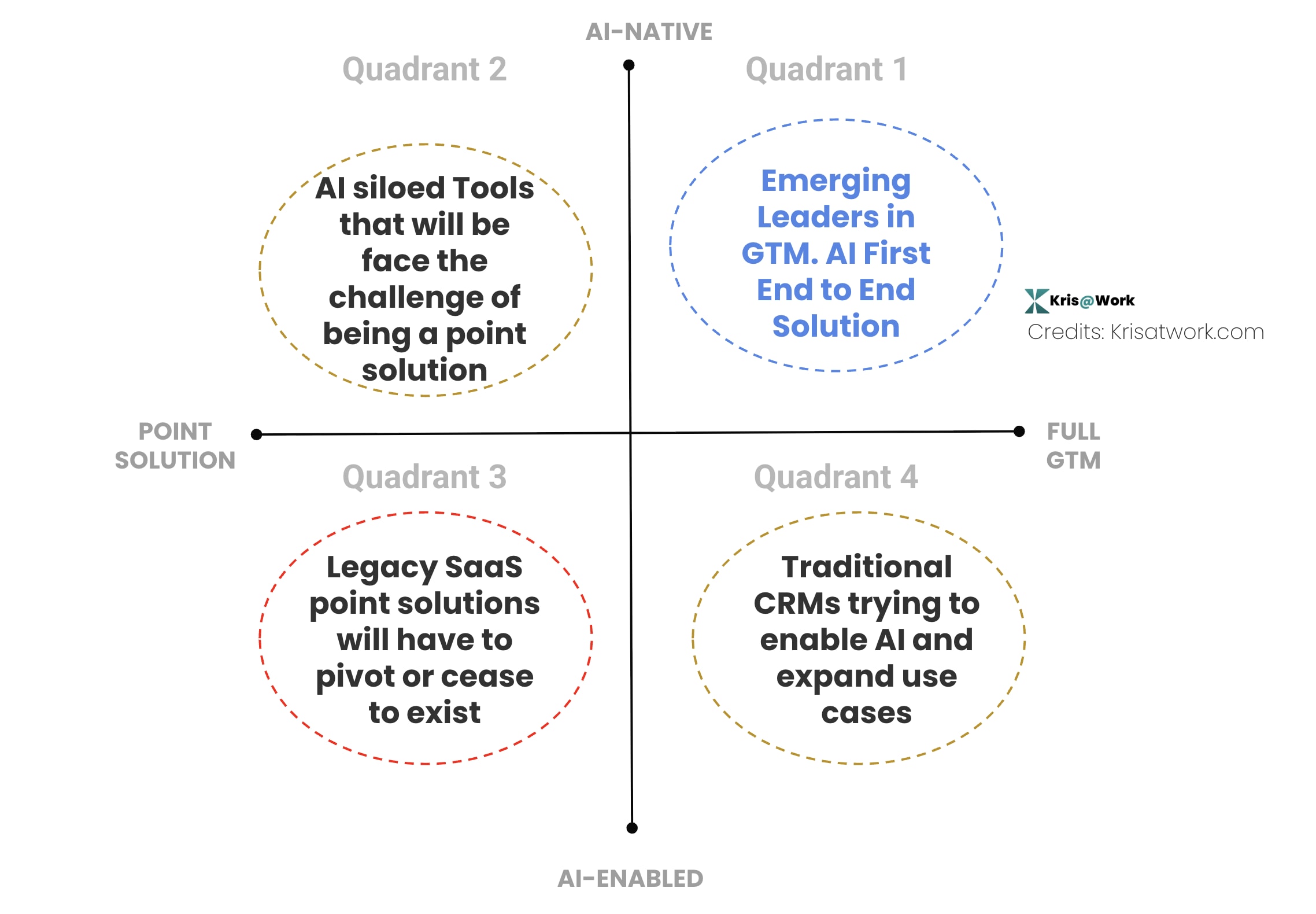
For GTM and sales technology companies, the competitive landscape can increasingly be viewed through four quadrants.
Quadrant 1: AI-Native Full GTM Platforms
This is the category that is emerging as the future of sales technology.
Characteristics include:
- A single operating platform
- Agentic AI across the entire customer lifecycle
- End-to-end workflow automation
- Faster execution
- Real-time intelligence
- Reduced complexity
- Lower total cost of ownership
This quadrant represents the next evolution of Sales Intelligence Software.
Quadrant 2: AI-Native Point Solutions
These companies are AI-native and deliver strong capabilities within specific functions.
However, they will increasingly face a difficult question from customers:
"Why should I onboard multiple AI tools when I can deploy a single AI operating layer that manages the entire workflow?"
As consolidation accelerates, point solutions may face growing pressure to expand beyond their niche.
Quadrant 3: Legacy Point Solutions
This quadrant is at the highest risk of disruption.
These platforms are typically:
- Siloed
- Disconnected
- Expensive
- Operationally inefficient
Without significant transformation, many of these solutions risk becoming obsolete as AI-native alternatives continue to gain adoption.
Quadrant 4: Traditional Systems of Record
This includes the established CRM leaders and traditional enterprise platforms.
Their biggest challenge is defining their role in an "AI-on-Demand" world.
When information can be stored, retrieved, analyzed, and acted upon through simple conversations, customers may begin to question the need for complex interfaces, endless fields, and multi-page workflows.
The path forward likely involves evolving from systems of record into AI-native operating systems for revenue teams. However, that transformation will be neither simple nor quick.
The Bottom Line
The next wave of sales software will not be defined by individual features. It will be defined by the ability to orchestrate the entire go-to-market motion through a single AI-native operating layer.
The winners will be platforms that combine intelligence, automation, execution, and customer context across the full lifecycle—not just one stage of it.
The era of fragmented GTM stacks is being challenged by a new category: AI-Native Full GTM Solution and Kris@work is building exactly that. A single AI-native layer that gives every SDR, AE, and CSM the intelligence to perform like your best rep, across every stage of the revenue lifecycle, from first touch to closed-won to expansion.